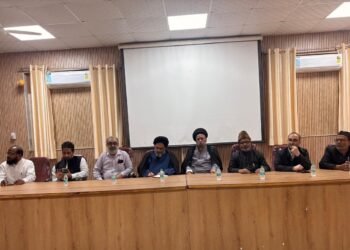

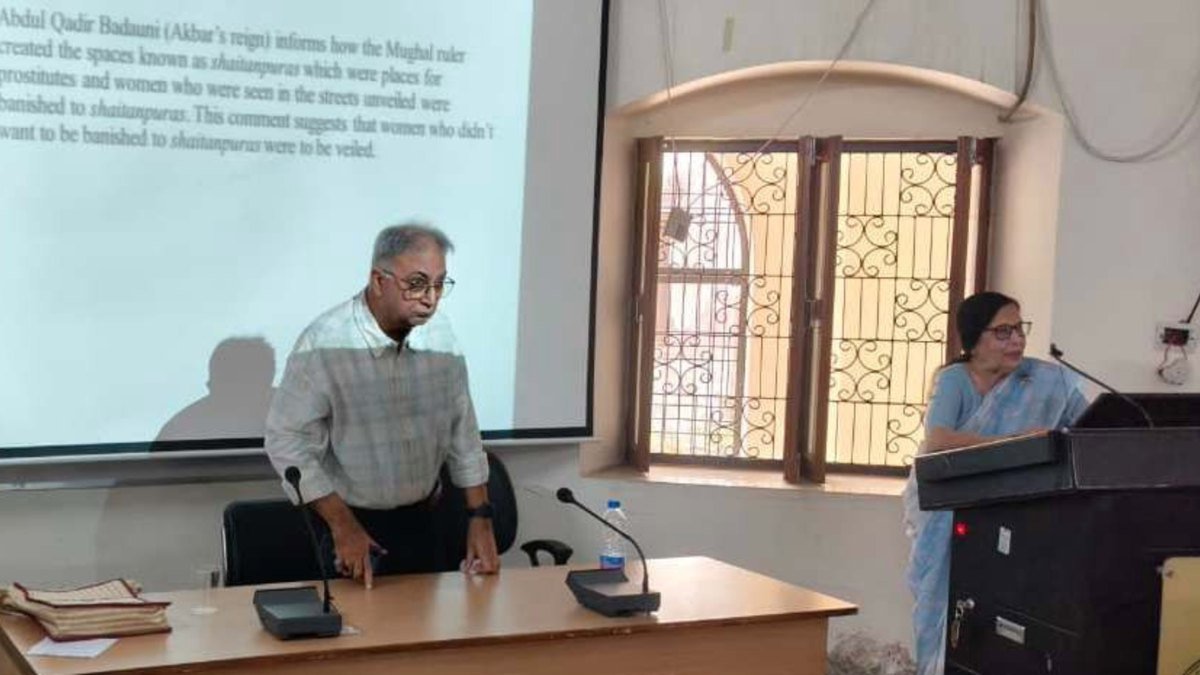
Were women in medieval India really shut away at home, seen only in palace chronicles? A symposium at Aligarh Muslim University has made a strong case that they were not. Historians from AMU and JNU used inscriptions, Mughal paintings, marriage contracts and port records to show women owning property, moving through markets and streets, and even taking part in military life.
The symposium, titled “Beyond Courts and Chronicles: Women, Gender and Everyday Life in Medieval India”, was held at the Centre for Women’s Studies. It was organised by the Aligarh Society of History and Archaeology (ASHA) with the Advanced Centre for Women’s Studies, AMU, and chaired by the noted historian Prof. Shireen Moosvi, former Director of the Centre.
Who spoke and on what
| Prof. R. Mahalakshmi, Centre for Historical Studies, JNU | Women’s representation and agency in early medieval South India, using inscriptions, texts and visual sources |
| Prof. S. Ali Nadeem Rezavi (retd.), formerly Department of History, AMU | Women, property and power in Mughal India, beyond the imperial household |
| Dr. Lubna Irfan, Department of History, AMU | Gendering the Mughal city: women, public spaces and the urban experience |
| Prof. Shireen Moosvi (chair) | Concluding remarks on women in public life from the Delhi Sultanate onwards |
Reading the sources with care
Prof. Mahalakshmi focused on early medieval Tamil society. She drew on inscriptions, literary texts and temple sculpture to look at women’s ties with royal courts and religious institutions. Referring to the work of gender historians Gerda Lerner and Uma Chakravarti, she said women’s history cannot be written just by spotting the few times women appear in standard narratives. Historians have to question the sources themselves: who produced them, when, and with what assumptions.
 Also readAMU Shia Theology and Islamic Studies Departments Explore Tie-Up With Iran’s Al-Mustafa International University
She also gave a useful warning for students of art history. A sculpture or painting shows an ideal, she said, not always real life. The gap between what was prescribed for women and how they actually lived has to be kept in mind.
Property, marriage contracts and the chahar shart
Prof. Rezavi, one of the best known names in Mughal social history at Aligarh, moved the focus away from the harem and the royal household. He used Mughal paintings, marriage contracts, seventeenth century records from the ports of Surat and Cambay, and Banarsidas’s autobiography Ardhakathanaka to show women active in social and economic life.
He spoke about the chahar shart (four conditions) that some Mughal era marriage contracts included. According to him, these clauses could protect a wife against being abandoned or ill treated, a reminder that women and their families sometimes used the law to secure their position.
Women in Mughal streets and markets
Dr. Lubna Irfan challenged the idea that women stayed inside the home. She pointed to Mughal paintings, the English chaplain John Ovington’s account of women fetching water from the panghat, and cases of women in military roles, including the wife of Mirza Rustam Safavi. Her point was simple: women were part of the city’s public life, on its streets and in its markets.
No single “medieval” woman
Closing the session, Prof. Shireen Moosvi said women’s role in public and political life did not begin with the Mughals. It can be traced back to the Delhi Sultanate, and Razia Sultan is the obvious example. She cautioned against treating medieval India as one unchanging era and said women’s lives must be read in their own social and political setting.
Prof. Azra Moosvi, Director of the Centre for Women’s Studies, gave the vote of thanks. Mr. Hassan Ullah Khan of the Department of History conducted the proceedings. The full report is on the AMU news page.
Why this matters for Aligs
The Aligarh school of history, built by scholars at the Department of History and its Centre of Advanced Study, is known worldwide for its work on Mughal India. Sessions like this one, open to students and research scholars, are a good chance to hear that tradition first hand. History and women’s studies students looking for dissertation ideas will find plenty here: marriage contracts, port records and city life are all areas where more work is needed.
Also read: Sir Syed Ahmad Khan: biography, books and legacy and 12 Urdu poets and writers who studied at AMU.
Frequently asked questions
What was the AMU symposium on women in medieval India about?
Titled “Beyond Courts and Chronicles: Women, Gender and Everyday Life in Medieval India”, it looked at women’s lives, property rights and presence in public spaces using inscriptions, paintings, marriage contracts and other records.
Who organised the symposium?
The Aligarh Society of History and Archaeology (ASHA) organised it with the Advanced Centre for Women’s Studies, AMU. Prof. Shireen Moosvi chaired it.
What is chahar shart in Mughal marriage contracts?
Chahar shart means four conditions. Prof. S. Ali Nadeem Rezavi explained that some Mughal era marriage contracts carried such conditions, which could protect a wife against abandonment and ill treatment.
Did women in Mughal India go out in public?
Yes. Dr. Lubna Irfan cited Mughal paintings and travellers’ accounts showing women in streets, markets and at water points, and some women even took part in military activities.