
The AMU Tarana was written by Asrarul Haq Majaz, the Urdu poet better known as Majaz Lakhnavi. He wrote the poem, titled Nazr-e-Aligarh, in the 1930s while he was a student at Aligarh Muslim University. A shortened version of it became the university’s official anthem in 1955, and Aligs have sung it ever since.
We have covered the anthem itself before on this site. This piece looks at the man who wrote it, how a student’s poem became the voice of the university, and why it still matters to Aligs. The lyrics are not reproduced here.
Who was Majaz
Asrarul Haq was born on 19 October 1911 in Rudauli, in present-day Ayodhya district of Uttar Pradesh. He wrote under the pen name Majaz, and because of his later years in Lucknow he came to be called Majaz Lakhnavi.
 Also readAMU Black Sherwani and Aligarh Culture: Dress, Adab and Customs
He finished school in Agra in 1929, studied at St John’s Intermediate College there and passed his intermediate examination in 1931. He then moved to Aligarh for his BA.
His years at Aligarh
At AMU, Majaz studied philosophy, economics and Urdu. He completed his BA in 1936, a year later than expected, and started an MA but left it for financial reasons.
Aligarh was where he became a poet with a following. Through K.M. Ashraf and Abdul Aleem, he came into contact with the Progressive Writers’ Movement, which shaped much of his later work.
Why it matters: The Tarana is not a commissioned song. It was written by a student about his own campus, which is part of why it feels personal to those who sing it.
The poem behind the anthem
The original poem is Nazr-e-Aligarh, which can be translated as “an offering to Aligarh”. Accounts differ on the exact year: Wikipedia gives 1933 while the Urdu poetry archive Rekhta gives 1936. Both place it in his student years.
The full poem runs to around ten stanzas. Its opening words, “Yeh mera chaman”, call the campus the poet’s garden. It uses images of gardens, nightingales, lightning and rain to describe Aligarh as a place of learning and awakening, and it carries a strong sense of pride in what the institution stands for.
The anthem sung today is an abridged version, a few stanzas long, so it can be performed at events.
How it became the official anthem
The widely cited account credits the musical setting to Khan Ishtiaq Mohammad, who composed the tune in 1955. In the same year, the abridged poem was adopted as the official anthem of the university.
Majaz died in Lucknow on 5 December 1955, at the age of 44, while the first Students’ Urdu Convention was being held in the city. His death came in the same year his student poem was formally made the university’s anthem.
Majaz beyond the Tarana
The Tarana is his best known work at AMU, but Majaz was a major name in Urdu poetry in his own right. His first collection, Ahang, came out in 1938. It was dedicated to Faiz Ahmed Faiz and Moin Ahsan Jazbi, and Faiz wrote its preface.
Later collections included Shab-e-Taar (1945) and Saaz-e-Nau (1949). His other well-known poems include “Aawara” and “Noora Nurse”.
He also worked in journalism and broadcasting. In 1937 he co-founded the magazine Parcham with Ali Sardar Jafri and Sibte Hasan, worked for about a year with All India Radio, and later joined the Bombay government’s Department of Information.
Majaz at a glance
| Item | Detail |
|---|---|
| Real name | Asrarul Haq |
| Pen name | Majaz (Majaz Lakhnavi) |
| Born | 19 October 1911, Rudauli, Uttar Pradesh |
| Died | 5 December 1955, Lucknow |
| At AMU | BA, completed 1936 |
| Poem behind the Tarana | Nazr-e-Aligarh |
| Tune | Khan Ishtiaq Mohammad, 1955 |
| First collection | Ahang (1938) |
| Family link | Maternal uncle of Javed Akhtar |
The family connection
Majaz’s sister Safia was married to the poet Jan Nisar Akhtar. Their son is the screenwriter and lyricist Javed Akhtar, which makes Majaz his maternal uncle. Majaz was also the maternal uncle of psychoanalyst Salman Akhtar.
His brother Ansar Harvani was a journalist. In 2008, the Government of India issued a postage stamp in Majaz’s memory.
Why Aligs sing it
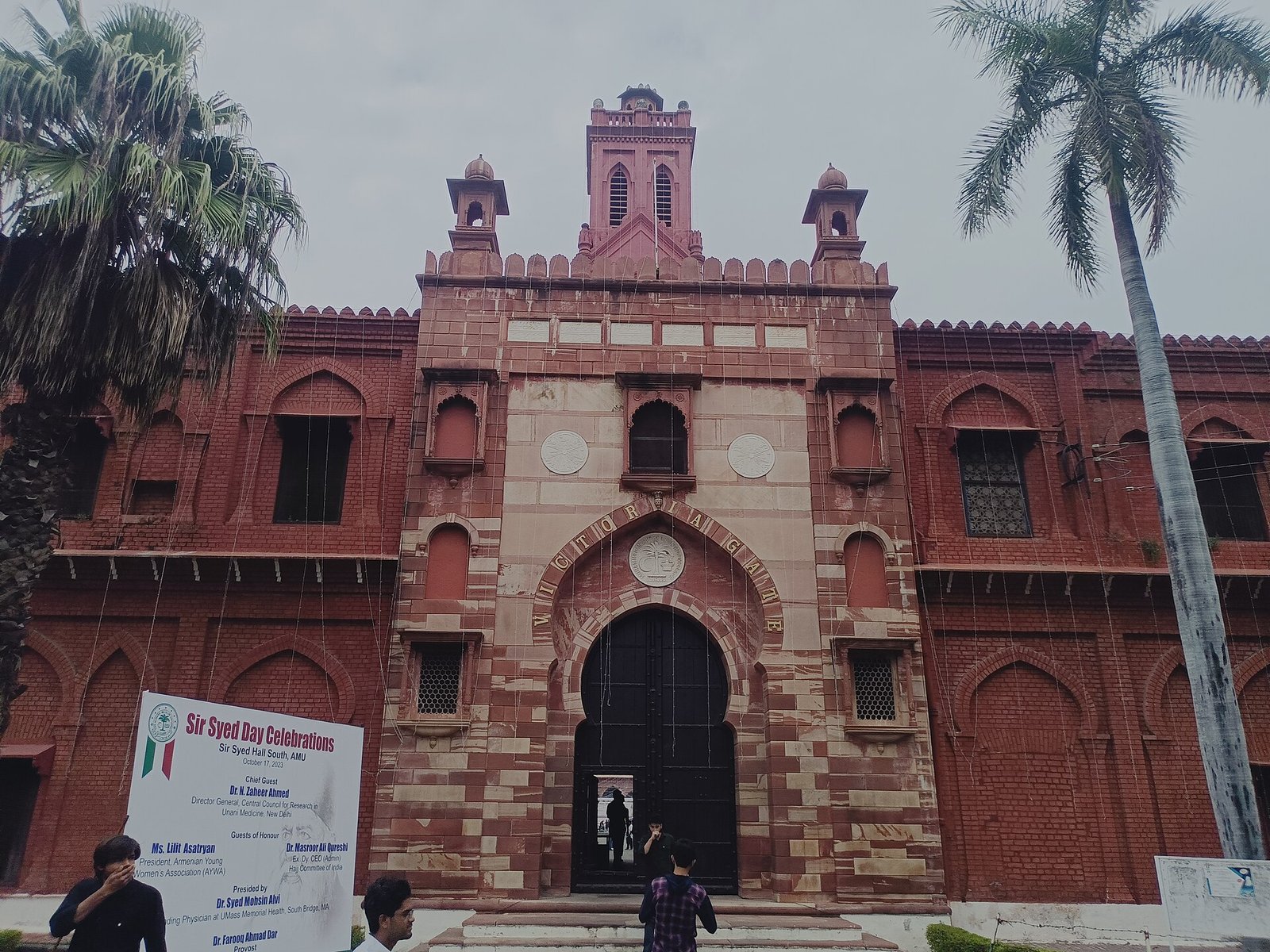
The Tarana is sung at university functions, including convocations and Sir Syed Day on 17 October. Alumni gatherings often end with it.
Alumni groups abroad also close their events with it. At a 2024 Sir Syed Day dinner held by the AMU alumni association in the San Francisco Bay Area, alumni gathered in front of the stage to sing the anthem, and much of the audience joined in. A 2025 report from Jammu and Kashmir described an alumni Sir Syed Day event that ended with the Tarana, followed by a traditional Aligarh dinner.
For many Aligs, it is the one piece of Urdu poetry they know by heart. Read more about campus customs in our Infotainment section and the university’s past in History.
Where to read the full poem
The complete text of Nazr-e-Aligarh is available on Rekhta, the online Urdu poetry archive, in more than one script. Reading the full poem shows how much was left out when it was shortened for the anthem.
The longer version also makes clear that Majaz wrote it as a personal tribute from a student to his college, not as a formal song for ceremonies.
Majaz on screen
A Hindi biographical film on the poet, Majaz: Ae Gham-e-Dil Kya Karun, directed by Ravindra Singh, was released in January 2017. Priyanshu Chatterjee played Majaz.
The film, in Hindi and Urdu, ran close to three hours. Reviews in The Times of India and The Free Press Journal were negative.
Frequently asked questions
Who wrote the AMU Tarana?
Urdu poet Asrarul Haq Majaz, known as Majaz Lakhnavi, wrote it while he was a student at AMU in the 1930s.
What is the original poem of the AMU Tarana called?
Nazr-e-Aligarh. The anthem is an abridged version of this poem.
When was the AMU Tarana adopted?
It was adopted as the official university anthem in 1955, with a tune credited to Khan Ishtiaq Mohammad.
Is Majaz related to Javed Akhtar?
Yes. Majaz was Javed Akhtar’s maternal uncle. Javed Akhtar’s mother Safia was Majaz’s sister.
Sources: Rekhta, Nazr-e-Aligarh; Wikipedia, Majaz (background); The Friday Times, November 2024; Greater Kashmir, October 2025.