
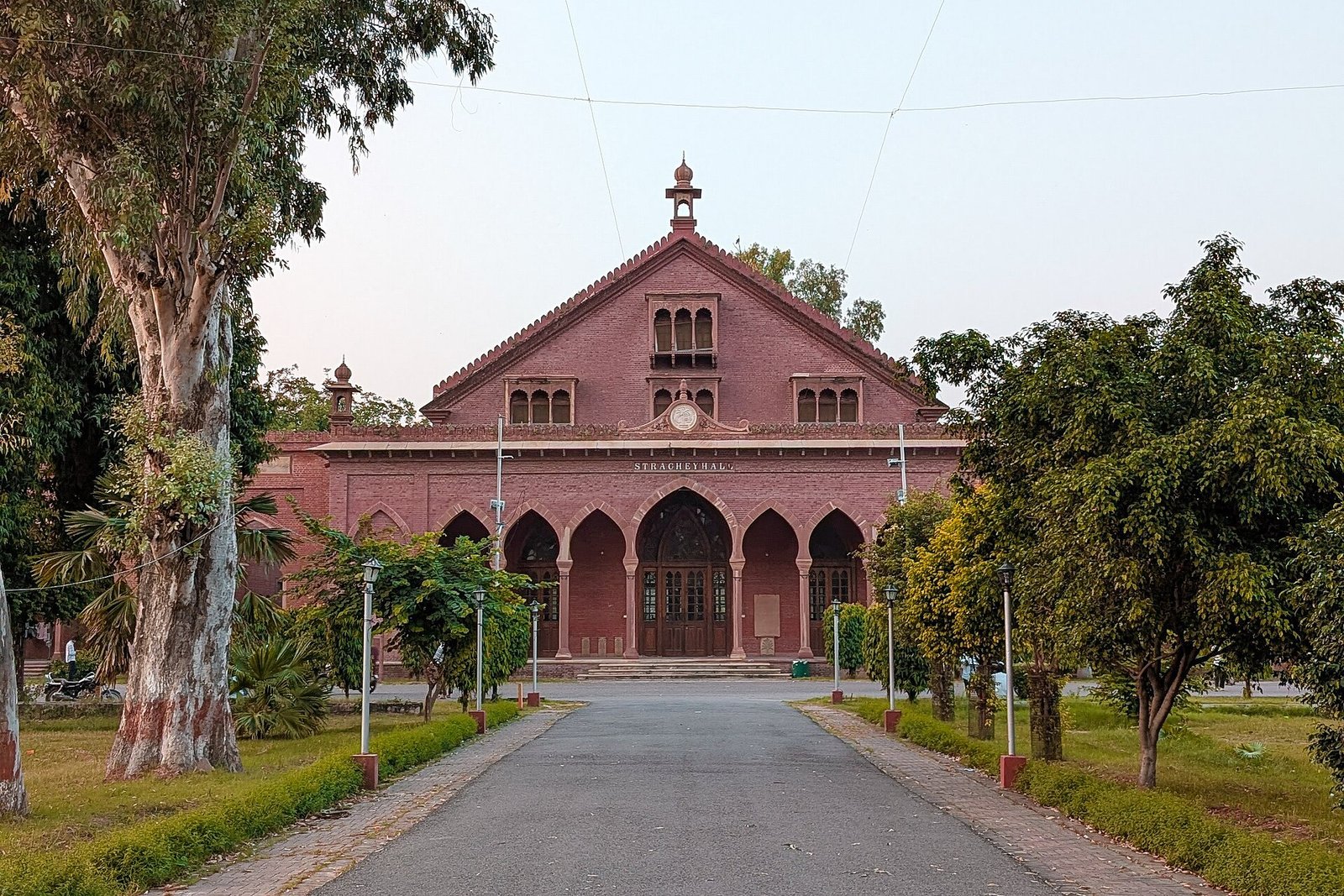
The most iconic landmarks of the AMU campus are Bab-e-Syed, Victoria Gate, Strachey Hall, the Sir Syed Mosque, Maulana Azad Library, Sir Syed House and the Musa Dakri Museum. Most of the oldest ones sit inside Sir Syed Hall, the original core of the MAO College founded in 1875.
Aligarh Muslim University’s campus is spread over about 467 hectares, roughly 1,155 acres. The ten buildings and gates below are the ones that appear most often in convocation photos, alumni memories and heritage walks. For background on how the college grew into a university in 1920, see our History section.
1. Bab-e-Syed
Bab-e-Syed, meaning the Gate of Syed, is the main gate of the university. It is the entrance most first-time visitors are directed to.
 Also readAligarh Food Guide: Famous Dishes and Food Streets to Try
Its name is a daily reminder of Sir Syed Ahmad Khan, and it is the natural starting point for any walk around the campus.
Why it matters: It is the public face of the university.
2. Victoria Gate
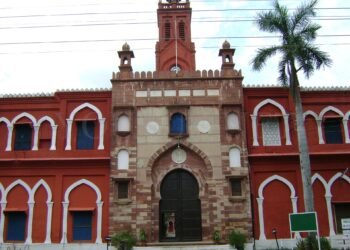
Victoria Gate, completed in 1883, stands on the southern side of Sir Syed Hall (South). Its clock tower makes it one of the most photographed structures on campus.
The university’s own Sir Syed Hall pages list it among the hall’s heritage structures, alongside Strachey Hall and the old Lytton Library.
Why it matters: It is the image most closely associated with AMU worldwide.
3. Strachey Hall
Strachey Hall is named after Sir John Strachey, Lieutenant-Governor of the North-Western Provinces from 1874 to 1876 and an early patron of the MAO College. It is one of the earliest structures of the college, whose foundation stone was laid by Lord Lytton, then Viceroy, in 1877.
The hall combines Mughal-style red brick with a colonial building plan. It has been used for major university gatherings and addresses by visiting leaders over more than a century.
Why it matters: Much of the college’s early public life took place here.
4. Sir Syed Mosque (University Jama Masjid)
The university’s Jama Masjid stands in the central courtyard of Sir Syed Hall. Construction began in 1879 under Sir Syed Ahmad Khan and was completed in January 1915. The design, prepared by the engineering college at Roorkee, follows the pattern of the Shahi Masjid in Delhi.
The mosque has three domes and two minarets. Sir Syed’s tomb lies beside it, which makes it a place of quiet visits for alumni returning to campus.
Why it matters: It is the resting place of the university’s founder.
5. Maulana Azad Library
The library’s story starts in 1877 as the Lytton Library, named after Lord Lytton. The present seven-storey building was inaugurated by Jawaharlal Nehru in 1960 and named after Maulana Abul Kalam Azad, India’s first Education Minister.
It holds roughly 18 lakh items, including books, periodicals, paintings and about 15,000 rare manuscripts. Its collection includes Mughal farmans and a 1572 Latin translation of Ibn al-Haytham’s Book of Optics.
Why it matters: It is the university’s central library and its most valuable research collection.
6. Sir Syed House and the Sir Syed Academy
Sir Syed House was a military mess before Syed Mahmood, the first Indian judge of the Allahabad High Court, bought it in 1876 for his father. After years of neglect it was restored in the early 1970s.
It now houses the Sir Syed Academy, inaugurated on 22 October 1974, with Prof. Khaliq Ahmad Nizami as founder director. Its museum has three galleries with Sir Syed’s belongings, letters and records of the MAO College.
Why it matters: It is the most direct link to Sir Syed’s own life in Aligarh.
7. Kennedy Hall Complex and the Musa Dakri Museum
The Kennedy Hall Complex, home to the Kennedy Auditorium, also houses the Musa Dakri Museum. The museum is named after a donor, Musa Dakri, whom the university describes as a generous benefactor.
According to AMU, the museum holds more than 1,366 archaeological artefacts, 30 sculptures from the Sir Syed collection and finds from the excavation at Atranjikhera in Etah district, a site dated from about 2000 BC to AD 1600.
Why it matters: It is the campus’s main public museum of archaeology.
8. Asman Manzil, Mushtaq Manzil and the Nizam Museum
These buildings form part of the Sir Syed Hall heritage cluster along with Strachey Hall and the old Lytton Library. Sir Syed Hall was split into North and South halls in the 1980s for administrative reasons, but the buildings are still seen as one complex.
The Nizam Museum building, now in Sir Syed Hall (North), once held the collection that later moved to the Musa Dakri Museum. Residents of these hostels live inside the oldest part of the university.
Why it matters: They show what the MAO College looked like in its early decades.
9. Faiz Gate
Faiz Gate stands near University Circle. AMU’s Aftab Hall history notes that it was built by Mumtaz-ud-Daula Nawab Sir Mohammad Faiyaz Ali Khan of Pahasu in memory of his father.
The same family’s support is recorded in the Latouche-Mumtaz hostel of Aftab Hall, whose foundation was laid in 1903.
Why it matters: It is a reminder of the donors who funded the early campus.
10. Centenary Gate
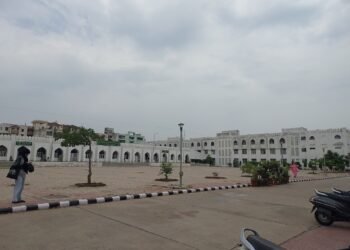
The Centenary Gate was built in 2020 to mark 100 years since the MAO College became Aligarh Muslim University under the AMU Act of 1920.
It is the newest of the main campus gates and stands in contrast to the 19th-century brick structures of Sir Syed Hall.
Why it matters: It marks the university’s second century.
Quick facts: AMU campus landmarks
| Landmark | Key date | Note |
|---|---|---|
| MAO College | 1875 | Foundation stone of college buildings laid by Lord Lytton, 1877 |
| Sir Syed House | Bought 1876 | Houses Sir Syed Academy since 1974 |
| Sir Syed Mosque | 1879 to 1915 | Sir Syed’s tomb beside it |
| Victoria Gate | 1883 | Clock tower, south of Sir Syed Hall |
| Maulana Azad Library | 1877 (Lytton Library), 1960 building | Seven storeys, about 15,000 manuscripts |
| Centenary Gate | 2020 | Marks 100 years as a university |
Most of these buildings are inside working halls and departments, so visitors should follow university security rules. More campus guides are in our Students’ Corner.
Frequently asked questions
What is the most famous building in AMU?
Victoria Gate, completed in 1883, is the most recognised. Strachey Hall and the Sir Syed Mosque in the same complex are equally central to the university’s history.
Where is Sir Syed Ahmad Khan buried?
Sir Syed’s tomb is beside the Sir Syed Mosque, the university Jama Masjid, in the courtyard of Sir Syed Hall on the AMU campus.
When was Maulana Azad Library built?
The library began as the Lytton Library in 1877. Its present seven-storey building was inaugurated by Jawaharlal Nehru in 1960.
Is the AMU campus open to visitors?
AMU is a working university with security at its gates. Visitors can usually see public areas, but entry rules for halls, the library and museums are set by the university.
Sources: AMU, Sir Syed Hall (South), AMU, Sir Syed Academy, AMU, Musa Dakri Museum, Maulana Azad Library (Wikipedia).