
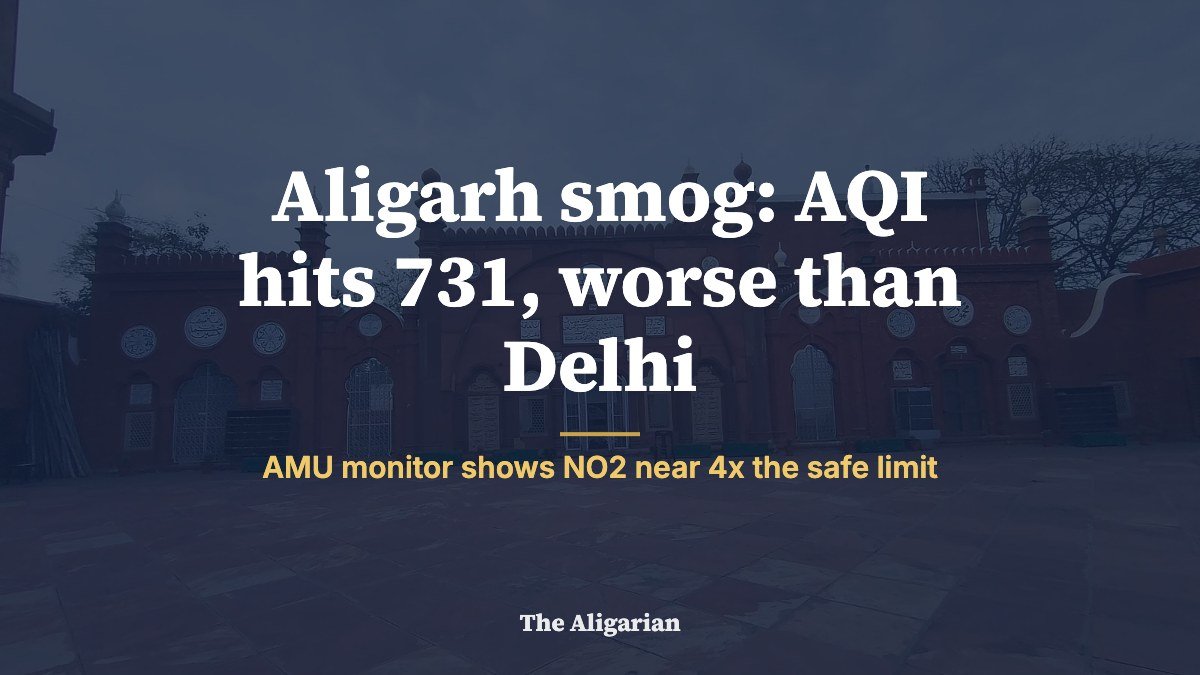
Aligarh’s air has turned hazardous this week, with a private air-quality tracker showing a reading of 731 at 9:30 am on Friday, 6 November 2026, slightly worse than Delhi’s peak of 728 at the same time. Students, the elderly and anyone with asthma should limit time outdoors in the morning and evening, when the haze is thickest.
According to sources, the city’s pollution level stayed above 500 from 5 November to the morning of 6 November, and complaints of burning eyes, sore throat and breathlessness have gone up.
What AMU’s monitor recorded
Aligarh has no air monitoring station of the Pollution Control Board. Dr Vishwanath Sharma, Regional Officer of the Board, said the city depends on data from AMU. The air monitor at AMU’s Department of Civil Engineering recorded:
 Also readJNMC Hospital OPD Closed on 9 November for Deepawali; Emergency Stays Open
| Pollutant | Recorded (per cubic metre) | Safe level |
|---|---|---|
| PM10 | 194.9 | 100 or less |
| PM2.5 | 60.69 | 60 |
| Nitrogen dioxide | 303.35 | 80 or less |
| Sulphur dioxide | 24.50 | 80 or less |
PM10, PM2.5 and nitrogen dioxide are all above the safe mark. Nitrogen dioxide, which comes mostly from vehicle exhaust and burning fuel, is nearly four times the limit.
Why the smog is building up
Prof Atiq Ahmad, a former scientist in AMU’s Department of Geography, said the haze is a mix of pollution and weather. As winter sets in, wind slows down and moisture rises. At night the air near the ground cools while a warmer layer sits above it, a condition called temperature inversion. That warm layer acts like a lid and stops dust and smoke from rising, so pollutants hang over the city for long hours.
Local sources make it worse: dust from road and building work, including on Ramghat Road, smoke from diesel and petrol vehicles, factory emissions, household fuel, and open burning of garbage.
Most polluted areas
The worst-hit spots include Ramghat Road PAC, Quarsi crossing, Banna Devi Numaish Ground, ITI Road, Sasni Gate industrial area, Etah Chungi, Sarsaul crossing, Gadiya Elampur, Barola bypass, Firdaus Nagar, AMU Qila Road, Delhi Gate, Lal Masjid, Rorawar, Bhujpura and Mathura Road.
How to protect yourself
- Avoid morning walks, jogging and outdoor sport until the air clears. Exercise indoors instead.
- Wear a well-fitted N95 mask if you must go out, especially through Quarsi, Ramghat Road or the industrial belt.
- Keep windows shut in the early morning and late evening.
- People with asthma, heart or lung conditions should keep their medicines handy and see a doctor if breathing gets harder.
- Go easy on crackers this Diwali. They add smoke at the worst possible time.
If you need a doctor over the holiday, note that the JNMC OPD is closed on 9 November, though the emergency stays open. Our guide to hospitals in Aligarh lists other options.
Frequently asked questions
What is the AQI in Aligarh today?
A private tracker showed Aligarh’s AQI at 731 at 9:30 am on 6 November 2026, and it stayed above 500 from 5 to 6 November. Levels change by the hour, so check a live tracker before going out.
Does Aligarh have a government air quality monitoring station?
According to the Regional Officer of the Pollution Control Board, Aligarh has no station of its own and relies on the monitor at AMU’s Department of Civil Engineering.
Why is Aligarh’s air so bad in November?
Slow winds, more moisture and temperature inversion trap dust and smoke near the ground, while construction dust, vehicles, industry and garbage burning keep adding pollutants.
Which areas of Aligarh are most polluted?
Ramghat Road, Quarsi crossing, Numaish Ground, ITI Road, Sasni Gate industrial area, Etah Chungi, Sarsaul and AMU Qila Road are among the worst hit.