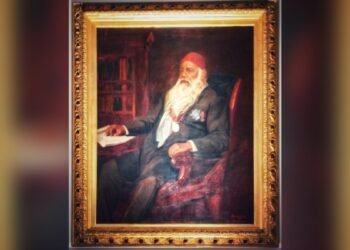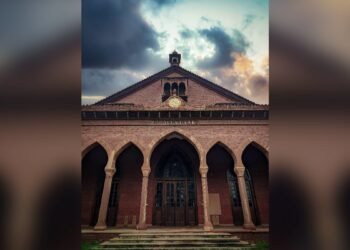

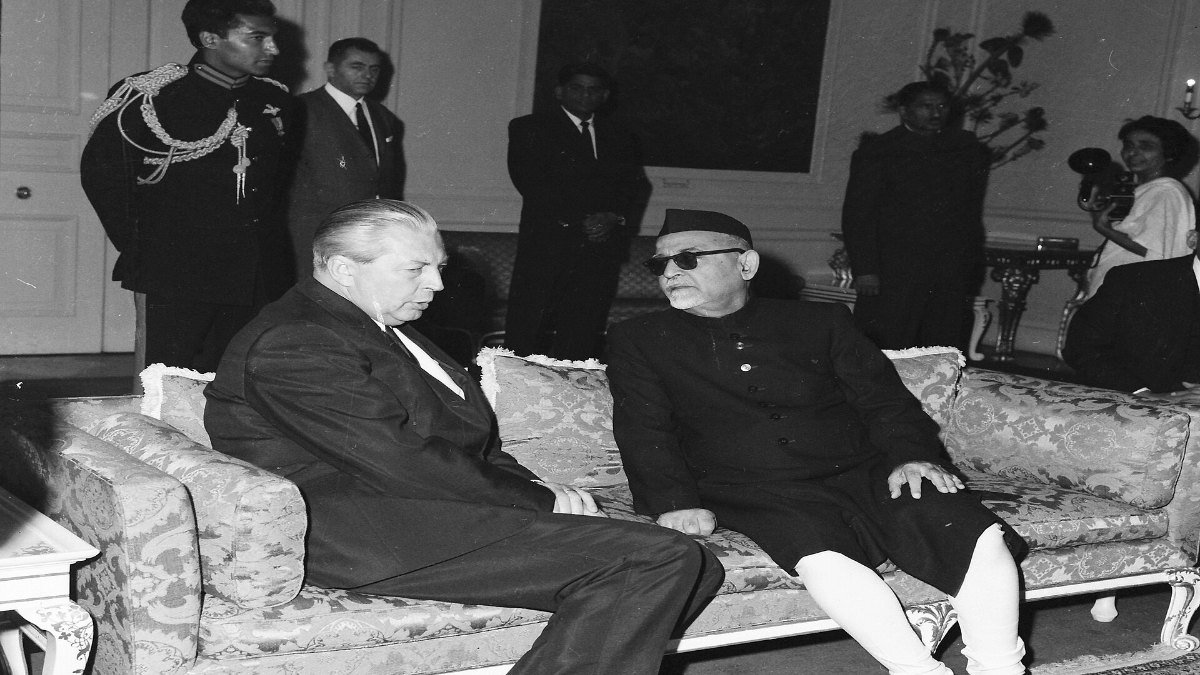
Dr Zakir Husain, India’s third President and the first Muslim to hold the office, was a student of the Muhammadan Anglo-Oriental (MAO) College, the institution that became Aligarh Muslim University in 1920. He studied at Aligarh from 1913, later taught there, helped found Jamia Millia Islamia from its campus, and returned in 1948 as AMU’s Vice-Chancellor. For Aligs, his life is one of the clearest examples of how far an Aligarh education travelled.
Zakir Husain at MAO College, Aligarh
Zakir Husain was born in Hyderabad on 8 February 1897. After his father’s death in 1907, the family moved back to Qaimganj in present-day Uttar Pradesh, and he finished school at Islamia High School, Etawah. He matriculated in 1913 and joined MAO College, Aligarh the same year.
His studies were not a straight line. He briefly enrolled at Lucknow Christian College for a science degree with medicine in mind, fell ill, and rejoined the college at Aligarh a year later. He graduated in 1918 with philosophy, English literature and economics.
 Also readAMU alumnus Saif Hyder Hasan teaches filmmaking to students in four-day CEC workshop
On campus he made a name as a debater and was elected vice-president of the college students’ union. He then studied law and economics, completed his master’s degree in 1920 and was appointed a lecturer at the college.
From Aligarh to Jamia Millia Islamia
In 1920 Mahatma Gandhi visited MAO College and called for non-cooperation with British rule. A group of teachers and students answered that call and, in October 1920, set up an independent national university at Aligarh. Zakir Husain was among its founders. The institution was later named Jamia Millia Islamia and shifted to Delhi in 1925.
He left for Germany in 1922 and earned a doctorate in economics from the University of Berlin in 1926, with a thesis on the agrarian structure of British India supervised by Werner Sombart. While in Berlin he worked with Alfred Ehrenreich to translate 33 of Gandhi’s speeches into German, published in 1924. On his return he became Sheikh-ul-Jamia, or Vice-Chancellor, of Jamia, a post he held until 1948. In 1937 he also chaired the Basic National Education Committee, which framed the Nai Talim scheme. It called for free and compulsory education in the child’s first language.
Vice-Chancellor of AMU, 1948 to 1956
After Independence, Zakir Husain came back to the place where he had studied. He took charge as Vice-Chancellor of AMU in November 1948, succeeding Nawab Mohammad Ismail Khan, and led the university until 1956. Education Minister Maulana Abul Kalam Azad had asked him to keep AMU a national institution of higher learning.
Between December 1948 and August 1949 he also served on the Universities Commission set up by the Government of India. The years were not easy. He suffered a heart attack in October 1949 and took regular charge again in early 1950. In 1951, Parliament passed the Aligarh Muslim University (Amendment) Act, and the university continued as a central institution maintained by the Government of India. Our list of AMU Vice-Chancellors places his term between Nawab Ismail Khan and Bashir Hussain Zaidi.
AMU’s engineering college, the Zakir Husain College of Engineering and Technology (ZHCET), carries his name today. The university’s Department of Economics also lists him among its notable alumni as “Ex-President of India and Former Vice Chancellor”.
A family tied to Aligarh
The Aligarh link ran through his family too. His brother Yusuf Husain, a historian and Sahitya Akademi Award winner, served as Pro Vice-Chancellor of AMU. His daughter Safia married Zil-ur-Rahman, a professor of physics at AMU, and his nephew Masud Husain became Professor Emeritus in Social Sciences at AMU before serving as Vice-Chancellor of Jamia.
His other daughter, Saeeda, married Khurshed Alam Khan, who served as a Union Minister and Governor. Their son Salman Khurshid became India’s External Affairs Minister in 2012.
Governor, Vice-President and President
| Role | Period |
|---|---|
| Nominated member, Rajya Sabha | 1952 to 1957 |
| Governor of Bihar | 1957 to 1962 |
| Vice-President of India | 1962 to 1967 |
| President of India | 13 May 1967 to 3 May 1969 |
He received the Padma Vibhushan in 1954 and the Bharat Ratna in 1963. He was elected President in 1967, succeeding Dr Sarvepalli Radhakrishnan.
Zakir Husain died at Rashtrapati Bhavan on 3 May 1969, the first President of India to die in office, according to the President of India’s website. He was buried on the campus of Jamia Millia Islamia in Delhi.
Why Aligs still remember him
Few alumni connect AMU, Jamia and Rashtrapati Bhavan in one life. Zakir Husain studied at Aligarh, left it to build a new university in the spirit of the freedom movement, and came back to steer AMU through the uncertain years after Partition.
He features in our list of famous AMU alumni who shaped modern India. Readers who want the wider background can also read our history of AMU from MAO College to university.
Frequently asked questions
Did Zakir Husain study at AMU?
Yes. He joined the Muhammadan Anglo-Oriental College, Aligarh, which became AMU in 1920, graduated in 1918 and completed his master’s degree in 1920.
When was Zakir Husain Vice-Chancellor of AMU?
He took charge in November 1948 and led the university until 1956.
Which AMU college is named after Zakir Husain?
AMU’s engineering college, the Zakir Husain College of Engineering and Technology (ZHCET), is named after him.
Was Zakir Husain the first Muslim President of India?
Yes. He became President on 13 May 1967 and was the first Muslim to hold the office.