
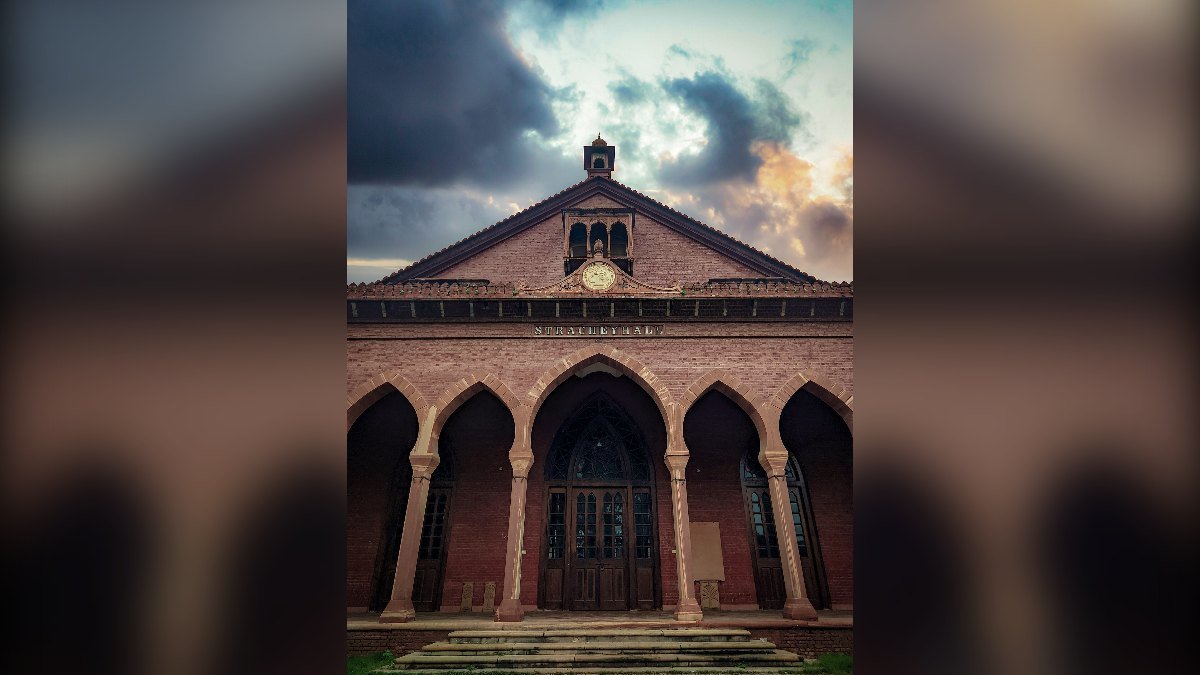
Strachey Hall is the oldest building on the Aligarh Muslim University (AMU) campus and the place where the Muhammadan Anglo-Oriental (MAO) College began to take physical shape. Its foundation was laid in 1877, when Viceroy Lord Lytton laid the foundation stone of the college, and it is named after Sir John Strachey, a British administrator and patron of the college. Nearly 150 years on, the hall still hosts some of the university’s most important gatherings.
Strachey Hall history: the first building of MAO College
Sir Syed Ahmad Khan opened his school, the Madarsatul Uloom, at Sami Manzil on Jail Road, Aligarh on 24 May 1875, with Hamidullah Khan as its first student. A boarding house with seven students followed on 1 June that year. According to AMU’s official timeline, Lord Lytton laid the foundation stone of the MAO College on 8 January 1877. Strachey Hall rose as the first major building of that college, a point repeated in a 2013 PTI report on plans to turn it into a museum.
Construction took years and money was always short. A June 2026 essay in The Friday Times notes that work stopped in 1885 for lack of funds, and that donors who gave Rs 500 were offered to have their names carved into the walls. Engraved stones carrying donors’ names can still be seen on the inner walls.
 Also readZakir Husain and AMU: The Alig Who Became President
The college grew around the hall through the 1880s. AMU’s timeline records that Sir Alfred Lyall, Lieutenant-Governor of the province, opened newly built classrooms on 5 February 1883, and that the Siddons Union Club, the forerunner of the Students’ Union, was inaugurated on 26 August 1884 under the presidency of Theodore Beck.
Who was Sir John Strachey?
Sir John Strachey (1823 to 1907) was a British civil servant who served as Lieutenant-Governor of the North-Western Provinces from 1874 to 1876 and then as finance member of the Viceroy’s council until 1880. He is described as a great patron of the MAO College, and the hall was named after him.
AMU’s timeline records that on 10 December 1880, Sir John Strachey paid a farewell visit to the college on the eve of his retirement from the Indian Civil Service.
Architecture of Strachey Hall
Sir Syed wanted his college to carry the feel of Oxford and Cambridge, which he had studied closely, while keeping an Indian identity. Strachey Hall reflects both ideas. It combines Mughal-style red brick with a plan drawn from British collegiate buildings.
One account of AMU’s architecture says Sir Syed could not afford a professional architect and worked out the designs of the early college buildings himself. The same account notes that the front wall of the hall is flat while the back wall is curved.
The hall sits within the Sir Syed Hall (South) complex. AMU lists it among the heritage buildings there along with Mushtaq Manzil, Asman Manzil, the Nizam Museum and the Lytton Library. Victoria Gate stands to the south, and the university Jama Masjid lies to the north-west. The old Sir Syed Hall was split into two halls, North and South, in 1983 for administrative reasons.
Strachey Hall at a glance
| Detail | Fact |
|---|---|
| Location | Sir Syed Hall (South) complex, AMU, Aligarh |
| Foundation | 1877, MAO College foundation stone laid by Lord Lytton |
| Named after | Sir John Strachey, Lieutenant-Governor of the North-Western Provinces (1874 to 1876) |
| Status | Oldest building of the college that became AMU in 1920 |
| Nearby heritage | Victoria Gate, Lytton Library, Nizam Museum, Jama Masjid |
A stage for history
For more than a century, Strachey Hall has been where AMU meets the outside world. The Friday Times essay lists Gandhi, Nehru, Ambedkar, Iqbal and Sarojini Naidu among those who came to the hall, along with Viceroys such as Lord Curzon, Lord Reading, Lord Irwin and Lord Willingdon.
The same essay links the hall to the All India Muslim Educational Conference. AMU’s timeline dates the inauguration of the conference to 22 December 1886, and it became one of the main platforms of the Aligarh Movement.
Strachey Hall today
The hall remains in active use for major university functions, and for most visitors it forms one short walk with Victoria Gate and the Jama Masjid. In October 2026, the closing session of AMU’s Seerat Week was held there, with 528 students taking part in the competitions, as we reported in AMU Seerat Week ends at Strachey Hall.
In 2013, then Vice-Chancellor Lt Gen (retd) Zameer Uddin Shah announced a plan to convert Strachey Hall into a museum and start a light and sound show on AMU’s history, according to the PTI report. Original MAO College drawings shown at an exhibition this month offered another look at how these buildings were first planned, which we covered in AMU architecture exhibition shows original MAO College drawings. For a walk through the rest of the old campus, see our guide to AMU campus landmarks.
Frequently asked questions
Why is it called Strachey Hall?
It is named after Sir John Strachey, a British administrator and patron of the MAO College who served as Lieutenant-Governor of the North-Western Provinces from 1874 to 1876.
When was the foundation of Strachey Hall laid?
The MAO College foundation stone was laid by Viceroy Lord Lytton on 8 January 1877, and Strachey Hall was the first building of the college.
Where is Strachey Hall located?
It is in the Sir Syed Hall (South) complex of AMU in Aligarh, with Victoria Gate to the south and the Jama Masjid to the north-west.
Is Strachey Hall still used today?
Yes. It hosts major university functions, such as the closing session of AMU’s Seerat Week in October 2026.