
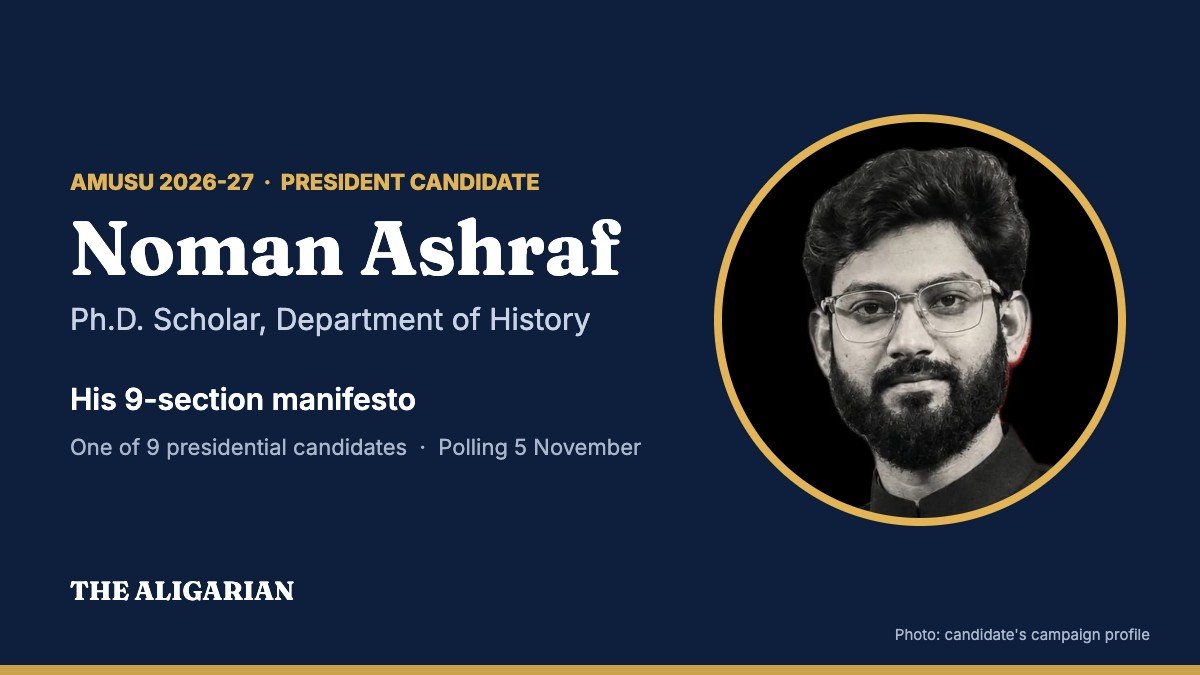
Noman Ashraf, a third-year Ph.D. scholar in the Department of History and a candidate for President in the AMU Students’ Union (AMUSU) 2026-27 election, has released a 21-page manifesto. It is titled “A Stronger Voice for a Better Campus” and runs across nine sections, from student services and research fellowships to women’s safety, placements and AMU’s centres outside Aligarh. Polling is on 5 November.

In his message to students, Ashraf says AMU has gone eight years without a union. He lists concerns he wants to raise: an outdated curriculum, a fall in NIRF rankings, encroachment on AMU land, fee hikes, and what he calls arbitrary suspensions and FIRs against students. These are the candidate’s own claims. He also writes that decision-making rests with the University’s statutory bodies, and that the Union’s role is to make the case “through the proper channels”.
Noman Ashraf’s manifesto at a glance
| No. | Section | Headline promise |
|---|---|---|
| 1 | Administration and student services | Fixed timelines for complaints and documents, with tracking numbers |
| 2 | Academics, research and libraries | Simpler fellowship process and a push to raise the stipend from Rs 8,000 to Rs 15,000 |
| 3 | Women’s safety and welfare | An anti-harassment cell at the Union and a women’s help desk |
| 4 | Hostels and infrastructure | A public hostel demand study and a phased expansion plan |
| 5 | Placements and alumni | A placement audit within two months and verified placement data |
| 6 | Sports and wellbeing | Published selection criteria and a gym in every hall |
| 7 | Culture, heritage and student voice | Open meetings, a revived convocation and work on AMU land and minority character |
| 8 | Accountability | A Student Concerns Register and quarterly public progress reports |
| 9 | AMU Centres | Polling at Kishanganj, Malappuram and Murshidabad and a Centre Liaison Desk |
1. Administration and student services
- A fixed time limit to acknowledge and answer every student complaint
- Reference numbers and status updates for applications, online and at a help desk
- Fixed timelines for transcripts, migration and provisional certificates, and bona fide letters
- A simple process to correct errors in names, enrolment details and marksheets
- All fees and deadlines published in one place, and faster refunds of fees and security deposits
- One online notice platform, offline help for first-year and rural students, and an online token system for subject counselling
2. Academics, research and libraries
- Less paperwork for fellowships, which he says now pass from supervisor to chairperson, dean, registrar and the grants section
- A push to raise the research stipend from Rs 8,000 to Rs 15,000 (the candidate’s figures)
- A published research calendar for registration, synopsis approval and thesis evaluation, and a grievance cell for scholars
- Travel and lodging support for seminars, fieldwork and research exchanges
- Ph.D. programmes in German and Chinese, and more Ph.D. seats in Strategic and West Asian Studies
- Departmental libraries open till 10:30 pm, 24×7 e-library access, new furniture and updated books
- A review of library timings for women students, a Braille section and a scribe bank for students with disabilities
- Exams and results on time, checked answer scripts shown in class, and anonymous student feedback on teaching
3. Women’s safety, dignity and welfare
- A women’s safety and anti-harassment cell at the Union that takes anonymous complaints
- Working CCTV cameras and street lighting in poorly lit areas, and more women in the proctorial team
- Longer outing time for women students and easier out passes
- General stores and visiting rooms in women’s hostels, and more women staff in hostels
- A review of the dining fee structure in consultation with women students
- Wider awareness of the Internal Committee, protection from retaliation for complainants, and strict action after a fair inquiry
- 24×7 ambulance service, weekly OPD in women’s hostels, a campus shuttle service, common rooms and sanitary napkin machines
4. Hostels and campus infrastructure
- A public study of hostel demand, capacity and waiting lists, followed by a phased plan for new hostels
- Timely allotment lists and a team to remove illegal occupants from rooms
- A complaint register in every hall, clean drinking water, power backup and better waste management
- Better internet, smart classrooms, working laboratories and accessible facilities for students with disabilities
- More doctors and a round-the-clock ambulance at the University Health Centre
- Specific asks for Dr. Ziauddin Ahmad Dental College, including equipment and water coolers
- Air conditioning in labs, lecture halls, reading rooms, libraries and mosques
5. Placements, careers and alumni
- A review of the placement system within two months of the Union taking office, presented to the General Body
- Placement plans for every faculty, wider employer outreach and verified placement figures
- NOCs, attendance relaxation and a separate window at the Controller of Examinations for students placed in January
- Workshops on CVs and interviews, a central list of internships, and guidance for civil services and judicial exams
- An alumni mentorship programme, and attention to women and first-generation students
6. Sports, fitness and wellbeing
- Repairs to grounds and courts, published timings and fair access for all halls and faculties
- Published selection criteria, announced trials and regular inter-hall and inter-faculty tournaments
- Nutrition, coaching and attendance relaxation for athletes, and more sports quota seats
- Equal access for women, a gym and sports ground in every hall, marathons, and quota seats for para-athletes
7. Culture, heritage and the student voice
- Regular open meetings, a published Union calendar and General Body Meetings on major decisions
- Decisions taken before the Union, the Women’s College Union and the General Body, as per the AMUSU Constitution 2010
- More funding and clubs in every department, and seminars with experts from different fields
- The Aligarh Movement and Sir Syed’s vision made part of student life, and the University convocation held again
- A better deal for international students, including accommodation and a help window
- Orientation for first-year students and sessions on Aligarh values with teachers and alumni
- Action on encroachment of AMU land through RTIs, petitions, memorandums and courts
- Raising AMU’s minority character with the administration and the Supreme Court
- Revocation of what he calls illegal suspensions and unfair FIRs
The manifesto also says Ashraf wants AMUSU to be a centre for wider discussion on national and social issues, including minority rights, security laws and women’s safety.
 Also readAMUSU Election 2026: Abdul Waheed’s Manifesto for President, 22 Commitments
8. Accountability and implementation
The manifesto sets out a reporting timeline for the Union:
| When | What the candidate promises |
|---|---|
| First 30 days | Concerns Register, working groups and meetings with the VC, Registrar, DSW, Proctor and Provosts |
| By 100 days | First memorandum on urgent concerns, with a public summary |
| Every quarter | A public progress report on issues raised, resolved and pending |
| Every semester | An open meeting, including an online session for Centre students |
| End of tenure | A final report on every major commitment and its status |
A note in the manifesto says that where it uses words like “advocate”, “seek” or “raise”, the Union will make the case with evidence, while decisions on policy, budgets and discipline rest with the University.
9. AMU Centres at Kishanganj, Malappuram and Murshidabad
- Polling booths at the three Centres, so students do not have to travel to Aligarh to vote
- Kishanganj: land and construction issues, faculty vacancies and facilities
- Malappuram: power cuts, teaching posts, health care and National Scholarship Portal verification
- Murshidabad: new courses, teaching quality, labs and internet
- A Centre Liaison Desk at the Union and regular online consultations
About the candidate
- Course: Ph.D. (third year), Department of History, AMU
- Post: President, AMUSU 2026-27
- Name on the official list: Mohd Noman Ashraf
The race for AMUSU President
Nine candidates are contesting for President: Mohammad Zuhair Ahmad, Amina Irshad, Mohd Intkhab, Abdul Waheed, Mohd Noman Ashraf, Sharjeel Iqbal, Sahil Khan, Sharjeel Mohammad Khan and Asmar Faridi. See every candidate in the AMUSU 2026 final candidate list.
The Aligarian does not support any candidate. We publish candidates’ own statements and manifestos so voters can compare them. Any AMUSU 2026-27 candidate can send us their manifesto, and we will cover it in the same way.
AMUSU 2026: polling day
- Polling: Thursday, 5 November 2026, 9 am to 5 pm, at the faculties
- Counting: from 6 pm the same day
Read more: Abdul Waheed’s manifesto, Mohd Intkhab’s pitch for President, the final candidate list and the AMUSU 2026-27 page.
Frequently asked questions
What are Noman Ashraf’s main promises for AMUSU 2026-27?
His manifesto promises fixed timelines for student complaints and documents, a higher research stipend, an anti-harassment cell at the Union, a hostel expansion plan, a placement review, and polling booths at AMU’s Centres.
Which department is Noman Ashraf from?
He is a third-year Ph.D. scholar in the Department of History at AMU.
What does the manifesto say about women students?
It promises a women’s safety cell and help desk, CCTV and lighting, longer outing time, visiting rooms and stores in women’s hostels, and a review of the dining fee in consultation with women students.
What does he promise for AMU’s Centres?
He says he will push for polling at the Kishanganj, Malappuram and Murshidabad Centres and set up a Centre Liaison Desk at the Union.
Does The Aligarian support Noman Ashraf?
No. The Aligarian does not support any candidate. Any AMUSU 2026-27 candidate can send us their manifesto for the same coverage.