
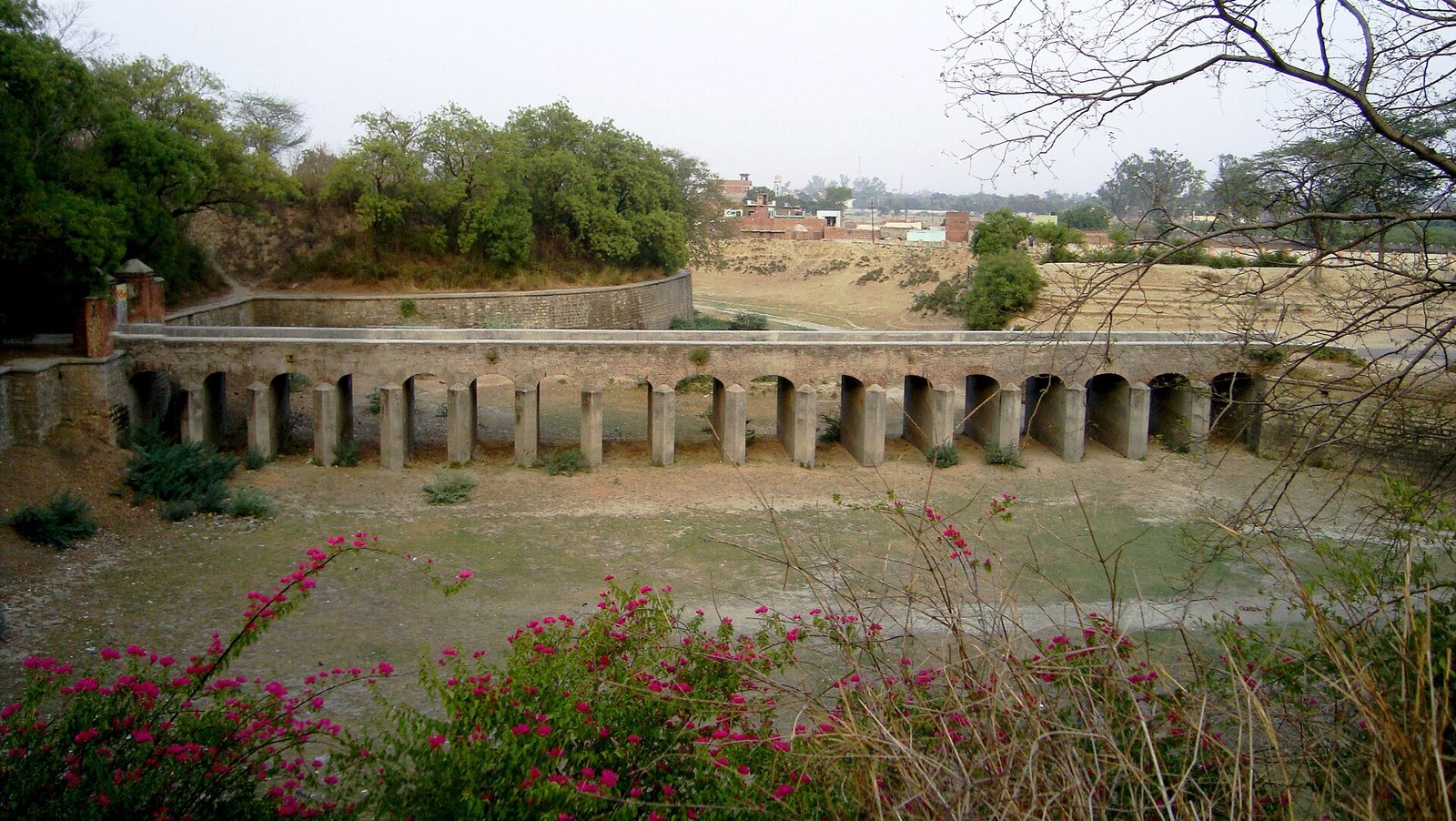
Aligarh Fort, also called Aligarh Qila, stands just north of the Aligarh Muslim University campus. First built in 1524 to 1525 under Ibrahim Lodi, it was rebuilt in the Mughal period, held by the Jats and Marathas, and captured by the British on 4 September 1803. Today it is a largely ruined site looked after by AMU.
The fort has changed hands, and names, several times in five centuries. Its story is also the story of how the town of Kol came to be called Aligarh.
Quick facts
| Detail | Information |
|---|---|
| Other names | Aligarh Qila; earlier linked to the names Muhammadgarh, Sabitgarh and Ramgarh |
| First built | 1524 to 1525, under Sultan Ibrahim Lodi |
| Builder | Muhammad, son of Umar, governor of Kol |
| Present design | French engineers under Benoit de Boigne and Pierre Perron |
| Battle of Aligarh | 1 to 4 September 1803, Second Anglo-Maratha War |
| Location | North of the AMU campus, off Barauli Road |
| Present use | Part of the interior is used by AMU’s Department of Botany |
Lodi origins: 1524 to 1525
The first fort on the site was built in 1524 to 1525 by Muhammad, son of Umar, who governed Kol under Sultan Ibrahim Lodi of Delhi. According to the Aligarh district administration’s history, he renamed the town Muhammadgarh after himself.
 Also readOld Name of Aligarh: From Koil to Aligarh, a Short City History
The fort stood on a small rise near the old route that later became the Grand Trunk Road, which gave it value for controlling movement through the Doab between the Ganga and the Yamuna.
Sabit Khan and the Mughal period
In the early 18th century, Sabit Khan, who governed the area under the Mughal emperors Farrukh Siyar and Muhammad Shah, rebuilt the old Lodi fort. The town was then called Sabitgarh after him.
As Mughal power weakened in the mid-1700s, the fort became a prize for rival powers in the region.
Jats, Ramgarh and the name Aligarh
In 1753, the Jat ruler Maharaja Surajmal of Bharatpur took control of the fort. The district administration records that the town was renamed Ramgarh in this period, and Surajmal’s officers are said to have expanded the fort, adding storage for explosives and other works.
Later, the Mughal commander Mirza Najaf Khan captured Ramgarh and gave it the name Aligarh, meaning “fort of Ali”. This happened in the 1770s, during his campaigns to recover Mughal strongholds. Some writers have argued that another commander was responsible for the renaming, but the district records credit Najaf Khan.
The Maratha and French fort
In the late 18th century the fort passed to the Scindias of Gwalior, the leading Maratha power in north India. With the help of the French soldier Benoit de Boigne, they used Aligarh as a base to train battalions in the European style.
The fort as it survives today is largely the work of French engineers under de Boigne and his successor Pierre Perron. It was laid out as a regular polygon with bastions at each angle, surrounded by a very wide and deep ditch, which made it one of the strongest forts in north India at the time.
Steep ravines more than 30 feet high ran along every side. For an attacker, the ditch and the angled bastions meant that any approach to the walls came under fire from more than one direction.
The Battle of Aligarh, 1803
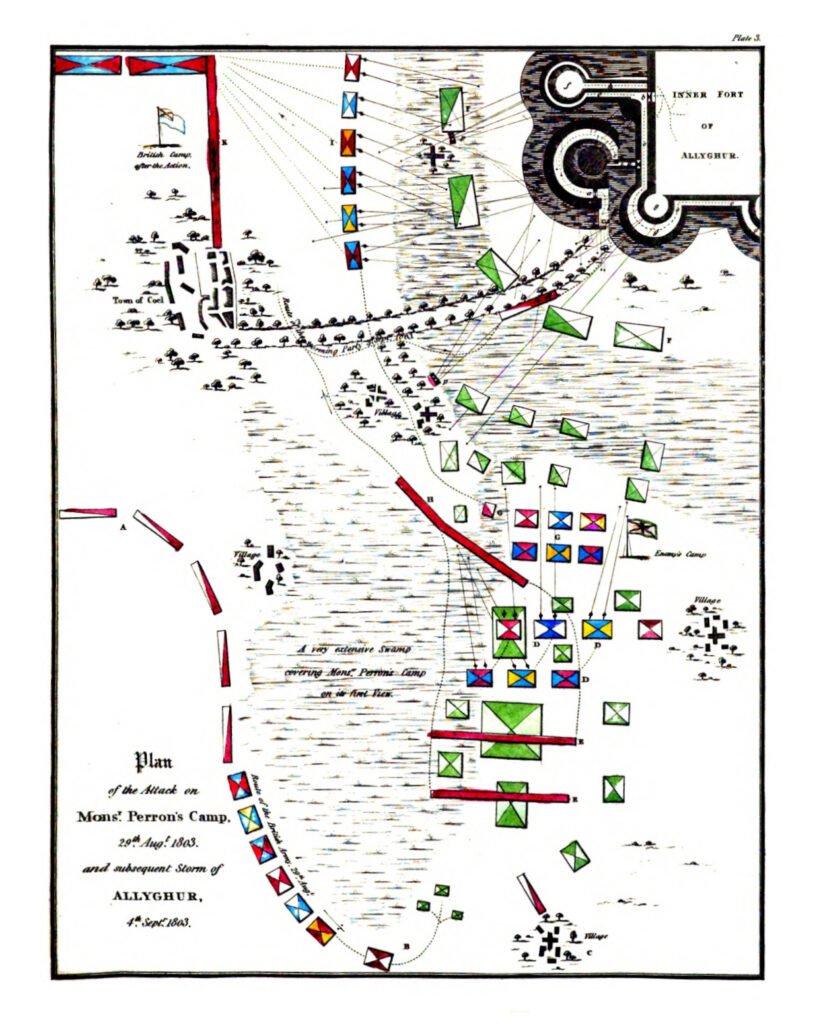
The Second Anglo-Maratha War brought British forces under General Gerard Lake to Aligarh. The siege began on 1 September 1803. Perron commanded the fort for the Marathas, and the defenders had lined the ditches with sword blades and spiked barriers.
The fort fell to the British on 4 September 1803. The 76th Regiment of Foot, an ancestor of today’s Yorkshire Regiment, played a leading part in the assault. Arthur Wellesley, later the Duke of Wellington, described it as “one of the most extraordinary feats of the British conquest of Northern India”.
The capture opened the road to Delhi, and Lake’s army defeated the Marathas at the Battle of Delhi on 11 September 1803. The British formed Aligarh district in 1804 and strengthened the fort further.
For the Marathas, the loss of Aligarh meant giving up an important depot and training base in the Doab, and Lake’s army was able to move north towards Delhi within days.
1857 and after
During the revolt of 1857, the Indian troops stationed at Aligarh rose against British control. They did not kill their officers, and the officers, residents and their families made their way to Hathras.
Over the 19th century the town around the fort grew into a centre of education, with the MAO College founded in 1875 and becoming Aligarh Muslim University in 1920. For the wider story of the city, see our Aligarh section.
Aligarh Fort today
The fort lies north of the AMU campus, off Barauli Road, and is cared for by the university. Part of the interior is used by AMU’s Department of Botany, and a small primary school also runs inside the premises.
Much of the structure is damaged and in ruins, though parts of the walls, bastions and the old ditch survive.
The fort should not be confused with the older fortress site in the heart of the city, which Britannica describes as now occupied by an 18th-century mosque. Since the site sits within university-managed land, it is best to check access locally before planning a visit. More on the city’s past is in our history section.
Frequently asked questions
Who built Aligarh Fort?
The first fort was built in 1524 to 1525 by Muhammad, son of Umar, governor of Kol under Ibrahim Lodi. The present design is the work of French engineers under de Boigne and Perron in the late 18th century.
When was the Battle of Aligarh fought?
The siege began on 1 September 1803, and British forces under General Lake captured the fort on 4 September 1803, during the Second Anglo-Maratha War.
Why was Aligarh Fort called Ramgarh?
The town was renamed Ramgarh after Jat ruler Surajmal took the fort in 1753. Najaf Khan later renamed it Aligarh.
Can you visit Aligarh Fort?
The fort is on land cared for by AMU, and part of it is used by the Department of Botany. Since it sits within university-managed land, check access locally before planning a visit.
Sources: Aligarh district: History, Wikipedia: Aligarh Fort, Wikipedia: Battle of Ally Ghur.