
Monday, 23 November 2026AMU · Alumni · Aligarh
AboutEditorial PolicyContactAdvertise
The AligarianThe AligarianAMU · Alumni · Aligarh
  • News
    • Sections
      • AMU Updates
      • Students
      • Campus Connect
      • Aligarh City
    • Campus life
      • Sir Syed Day
      • Why AMU students are called Aligs
      • AMU first-year survival guide
  • AMUSU
    • Election 2026-27
      • Results and winners
      • Cabinet 2026-27 with votes
      • Live results blog
      • AMU Court members 2026-27
    • Past unions
      • AMUSU 2018-19
      • AMUSU 2017-18
      • AMUSU 2016-17
      • AMUSU 2014-15
      • AMUSU office-bearers since 1884
      • All past unions
  • WCSU
    • Women’s College union
      • WCSU 2026-27 result
      • WCSU elections and office-bearers
      • WCSU news
    • Past WCSU unions
      • WCSU 2018-19
      • WCSU 2017-18
      • WCSU 2016-17
      • WCSU 2014-15
  • Alumni
    • Famous Aligs
      • Famous AMU alumni
      • AMU alumni in Bollywood
      • AMU alumni in sports
      • Women of AMU
      • Urdu poets from AMU
    • Connect with Aligs
      • Alumni news
      • AMU alumni WhatsApp and Telegram
      • Find Aligs near you
  • History
    • History and heritage
      • Literature
      • AMU Vice-Chancellors list
      • Who wrote the AMU Tarana
      • Maulana Azad Library
      • All unions since 1884: President, VP, Secretary
  • Jobs
  • AMU Guide
    • Admissions and study
      • AMU admission 2027
      • AMU cut-off
      • Previous year papers
      • Best books for AMU entrance
    • Inside AMU
      • AMU departments list
      • AMU placements
  • More
    • Listicles
    • Infotainment
    • Education
    • Featured
  • Join Alig Network
No Result
View All Result
The AligarianThe AligarianAMU · Alumni · Aligarh
No Result
View All Result

Aligarh Fort History: Lodi Fort to the 1803 Battle of Aligarh

The Aligarian Desk by The Aligarian Desk
9 October 2026
in History
0
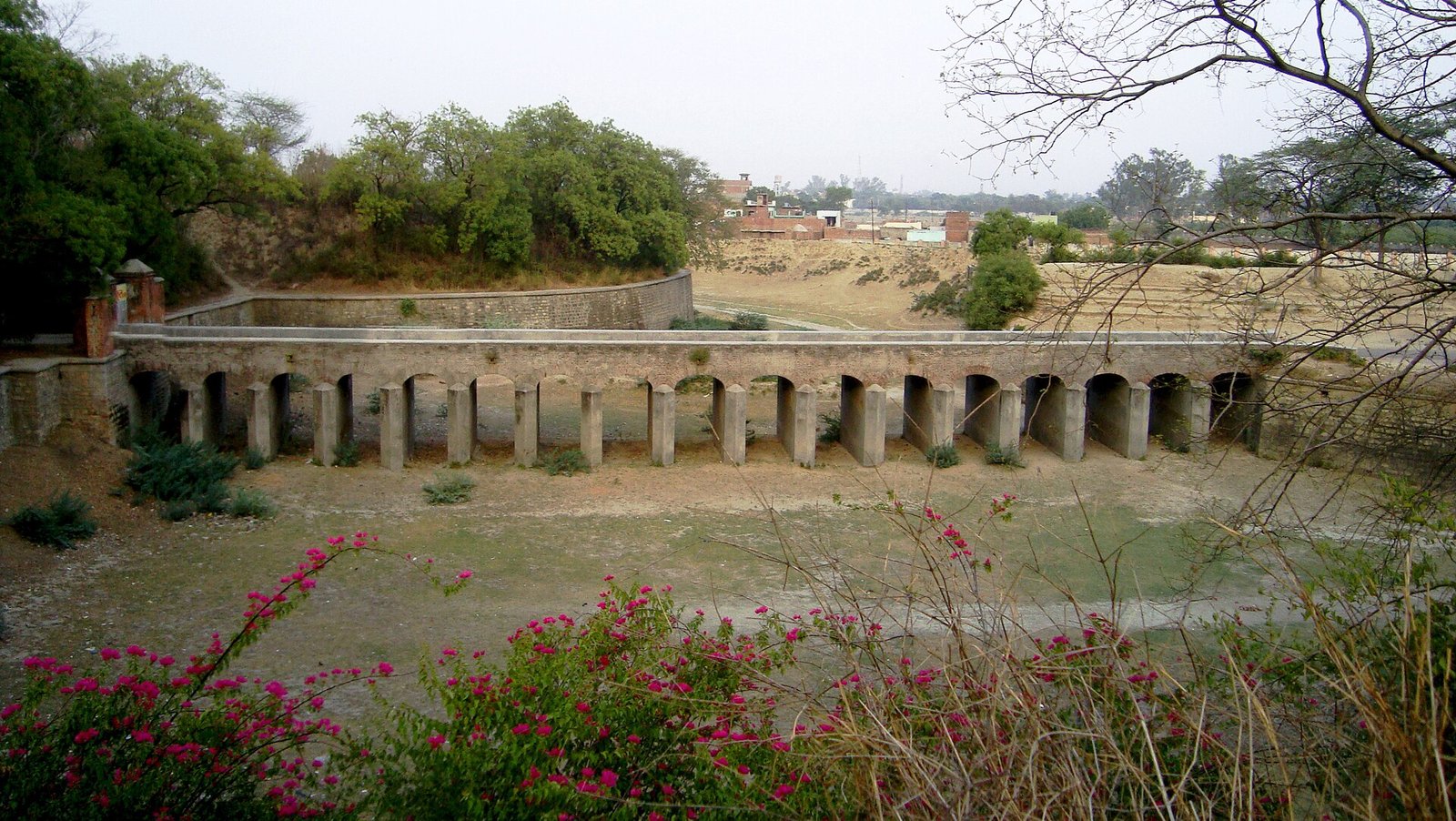
Walls of Aligarh Fort

Photo: Umar Tariq, CC BY-SA 3.0, via Wikimedia Commons

Share on FacebookShare on Twitter
6 min readGAdd The Aligarian as a preferred source on Google
Key takeaways
Aligarh Fort was first built in 1524 to 1525 by Muhammad, son of Umar, governor of Kol under Ibrahim Lodi.Its present design is the work of French engineers under de Boigne and Perron.British forces under General Lake captured it on 4 September 1803 after a siege that began on 1 September.Today the largely ruined fort lies north of the AMU campus and is cared for by the university.

Aligarh Fort, also called Aligarh Qila, stands just north of the Aligarh Muslim University campus. First built in 1524 to 1525 under Ibrahim Lodi, it was rebuilt in the Mughal period, held by the Jats and Marathas, and captured by the British on 4 September 1803. Today it is a largely ruined site looked after by AMU.

The fort has changed hands, and names, several times in five centuries. Its story is also the story of how the town of Kol came to be called Aligarh.

Quick facts

Detail Information
Other names Aligarh Qila; earlier linked to the names Muhammadgarh, Sabitgarh and Ramgarh
First built 1524 to 1525, under Sultan Ibrahim Lodi
Builder Muhammad, son of Umar, governor of Kol
Present design French engineers under Benoit de Boigne and Pierre Perron
Battle of Aligarh 1 to 4 September 1803, Second Anglo-Maratha War
Location North of the AMU campus, off Barauli Road
Present use Part of the interior is used by AMU’s Department of Botany

Lodi origins: 1524 to 1525

The first fort on the site was built in 1524 to 1525 by Muhammad, son of Umar, who governed Kol under Sultan Ibrahim Lodi of Delhi. According to the Aligarh district administration’s history, he renamed the town Muhammadgarh after himself.
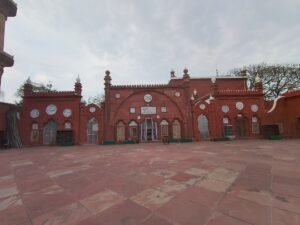
Old Name of Aligarh: From Koil to Aligarh, a Short City HistoryAlso readOld Name of Aligarh: From Koil to Aligarh, a Short City History

The fort stood on a small rise near the old route that later became the Grand Trunk Road, which gave it value for controlling movement through the Doab between the Ganga and the Yamuna.

Sabit Khan and the Mughal period

In the early 18th century, Sabit Khan, who governed the area under the Mughal emperors Farrukh Siyar and Muhammad Shah, rebuilt the old Lodi fort. The town was then called Sabitgarh after him.

As Mughal power weakened in the mid-1700s, the fort became a prize for rival powers in the region.

Jats, Ramgarh and the name Aligarh

In 1753, the Jat ruler Maharaja Surajmal of Bharatpur took control of the fort. The district administration records that the town was renamed Ramgarh in this period, and Surajmal’s officers are said to have expanded the fort, adding storage for explosives and other works.

Later, the Mughal commander Mirza Najaf Khan captured Ramgarh and gave it the name Aligarh, meaning “fort of Ali”. This happened in the 1770s, during his campaigns to recover Mughal strongholds. Some writers have argued that another commander was responsible for the renaming, but the district records credit Najaf Khan.
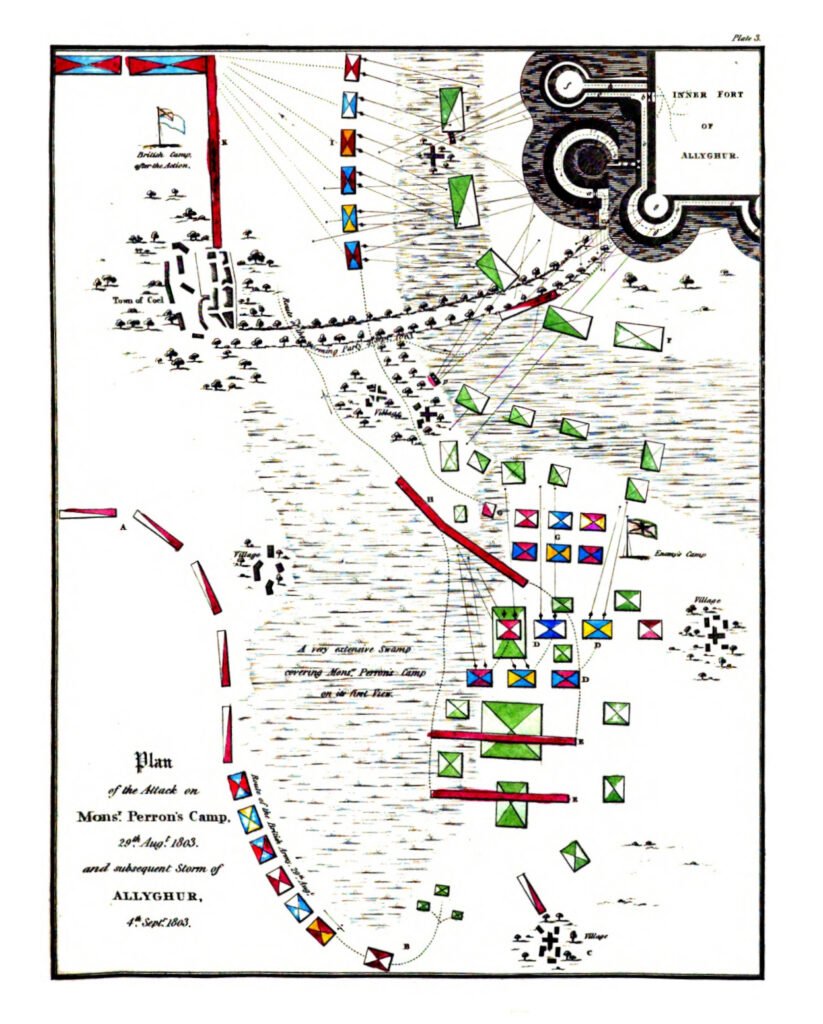
Historical print of the storming of Aligarh Fort in 1803
A historical print of the battle and storming of Aligarh, September 1803. Photo: Anonymous, Public domain, via Wikimedia Commons

The Maratha and French fort

In the late 18th century the fort passed to the Scindias of Gwalior, the leading Maratha power in north India. With the help of the French soldier Benoit de Boigne, they used Aligarh as a base to train battalions in the European style.

The fort as it survives today is largely the work of French engineers under de Boigne and his successor Pierre Perron. It was laid out as a regular polygon with bastions at each angle, surrounded by a very wide and deep ditch, which made it one of the strongest forts in north India at the time.

Steep ravines more than 30 feet high ran along every side. For an attacker, the ditch and the angled bastions meant that any approach to the walls came under fire from more than one direction.

The Battle of Aligarh, 1803

The Second Anglo-Maratha War brought British forces under General Gerard Lake to Aligarh. The siege began on 1 September 1803. Perron commanded the fort for the Marathas, and the defenders had lined the ditches with sword blades and spiked barriers.

The fort fell to the British on 4 September 1803. The 76th Regiment of Foot, an ancestor of today’s Yorkshire Regiment, played a leading part in the assault. Arthur Wellesley, later the Duke of Wellington, described it as “one of the most extraordinary feats of the British conquest of Northern India”.

The capture opened the road to Delhi, and Lake’s army defeated the Marathas at the Battle of Delhi on 11 September 1803. The British formed Aligarh district in 1804 and strengthened the fort further.

For the Marathas, the loss of Aligarh meant giving up an important depot and training base in the Doab, and Lake’s army was able to move north towards Delhi within days.

1857 and after

During the revolt of 1857, the Indian troops stationed at Aligarh rose against British control. They did not kill their officers, and the officers, residents and their families made their way to Hathras.

Over the 19th century the town around the fort grew into a centre of education, with the MAO College founded in 1875 and becoming Aligarh Muslim University in 1920. For the wider story of the city, see our Aligarh section.

Aligarh Fort today

The fort lies north of the AMU campus, off Barauli Road, and is cared for by the university. Part of the interior is used by AMU’s Department of Botany, and a small primary school also runs inside the premises.

Much of the structure is damaged and in ruins, though parts of the walls, bastions and the old ditch survive.

The fort should not be confused with the older fortress site in the heart of the city, which Britannica describes as now occupied by an 18th-century mosque. Since the site sits within university-managed land, it is best to check access locally before planning a visit. More on the city’s past is in our history section.

Frequently asked questions

Who built Aligarh Fort?

The first fort was built in 1524 to 1525 by Muhammad, son of Umar, governor of Kol under Ibrahim Lodi. The present design is the work of French engineers under de Boigne and Perron in the late 18th century.

When was the Battle of Aligarh fought?

The siege began on 1 September 1803, and British forces under General Lake captured the fort on 4 September 1803, during the Second Anglo-Maratha War.

Why was Aligarh Fort called Ramgarh?

The town was renamed Ramgarh after Jat ruler Surajmal took the fort in 1753. Najaf Khan later renamed it Aligarh.

Can you visit Aligarh Fort?

The fort is on land cared for by AMU, and part of it is used by the Department of Botany. Since it sits within university-managed land, check access locally before planning a visit.

Sources: Aligarh district: History, Wikipedia: Aligarh Fort, Wikipedia: Battle of Ally Ghur.

Enjoyed this story?Share it with your friends
WhatsAppLinkedInXFacebookEmail
See more The Aligarian stories on GoogleAdd us as a preferred source and our stories will show up more often in your Top Stories.
GAdd The Aligarian as a preferred source on Google
Follow The Aligarian Network on WhatsAppAMU news and alumni updates on your phone.
Follow channel
Tags: Aligarh FortAligarh historyAMUAnglo-Maratha WarBattle of Aligarh
The Aligarian Desk

The Aligarian Desk

The Aligarian Desk reports on Aligarh Muslim University, its alumni and Aligarh city, with news, history and student guides checked against official sources.

Related Stories

Best books on Sir Syed Ahmad Khan: portrait of the founder of Aligarh Muslim University

Best Books on Sir Syed Ahmad Khan to Read (November 2026)

by The Aligarian Desk
23 November 2026
0

Six books on Sir Syed Ahmad Khan worth reading or gifting this season, from a 2025 Oxford biography to his...

Strachey Hall AMU, the oldest building of the MAO College in Aligarh

Strachey Hall AMU: History of the Campus’s Oldest Building

by The Aligarian Desk
23 November 2026
0

Strachey Hall is the oldest building of the MAO College, founded in 1877 and named after Sir John Strachey. Here...

Zakir Husain AMU alumnus and former Vice-Chancellor who became President of India

Zakir Husain and AMU: The Alig Who Became President

by The Aligarian Desk
23 November 2026
0

Dr Zakir Husain studied at MAO College, Aligarh, helped found Jamia Millia Islamia from its campus, led AMU as Vice-Chancellor...

Prof. Shireen Moosvi at the symposium on women and gender in medieval India at the Centre for Women's Studies, AMU

Beyond the harem: AMU symposium shows how women lived, owned property and moved freely in medieval India

by The Aligarian Desk
14 November 2026
0

At an AMU symposium chaired by Prof. Shireen Moosvi, historians from AMU and JNU used inscriptions, Mughal paintings, marriage contracts...

Next Post
Who Wrote the AMU Tarana? Majaz and the Story of the Anthem

Who Wrote the AMU Tarana? Majaz and the Story of the Anthem

We are independent, non-profit online media platform for Aligs around the World.

  • About Us
  • Editorial Policy
  • Contact
  • Contribute
  • Contact
  • Privacy Policy
  • Disclaimer
  • Terms and Conditions

© 2017-2026 The Aligarian Network. AMU, alumni and Aligarh city.

No Result
View All Result
  • News
    • Sections
      • AMU Updates
      • Students
      • Campus Connect
      • Aligarh City
    • Campus life
      • Sir Syed Day
      • Why AMU students are called Aligs
      • AMU first-year survival guide
  • AMUSU
    • Election 2026-27
      • Results and winners
      • Cabinet 2026-27 with votes
      • Live results blog
      • AMU Court members 2026-27
    • Past unions
      • AMUSU 2018-19
      • AMUSU 2017-18
      • AMUSU 2016-17
      • AMUSU 2014-15
      • AMUSU office-bearers since 1884
      • All past unions
  • WCSU
    • Women’s College union
      • WCSU 2026-27 result
      • WCSU elections and office-bearers
      • WCSU news
    • Past WCSU unions
      • WCSU 2018-19
      • WCSU 2017-18
      • WCSU 2016-17
      • WCSU 2014-15
  • Alumni
    • Famous Aligs
      • Famous AMU alumni
      • AMU alumni in Bollywood
      • AMU alumni in sports
      • Women of AMU
      • Urdu poets from AMU
    • Connect with Aligs
      • Alumni news
      • AMU alumni WhatsApp and Telegram
      • Find Aligs near you
  • History
    • History and heritage
      • Literature
      • AMU Vice-Chancellors list
      • Who wrote the AMU Tarana
      • Maulana Azad Library
      • All unions since 1884: President, VP, Secretary
  • Jobs
  • AMU Guide
    • Admissions and study
      • AMU admission 2027
      • AMU cut-off
      • Previous year papers
      • Best books for AMU entrance
    • Inside AMU
      • AMU departments list
      • AMU placements
  • More
    • Listicles
    • Infotainment
    • Education
    • Featured
  • Join Alig Network

© 2017-2026 The Aligarian Network. AMU, alumni and Aligarh city.

The Aligarian

An independent magazine about Aligarh Muslim University, its alumni and Aligarh city. News, history, culture and practical guides, checked against official sources.

Share your Alig story →

Sections

  • News
  • AMU Updates
  • History
  • Listicles
  • Infotainment
  • Students

More to read

  • Aligarh City
  • Campus Connect
  • Literature
  • Education

The Aligarian

  • About us
  • Editorial policy
  • Contact
  • Advertise
© 2017-2026 The Aligarian Network
  • Privacy policy
  • Terms
  • Disclaimer

THE ALIGARIAN NETWORK

Join the global community of Aligs

Free for AMU alumni, students and teachers. Find Aligs in your city and get the weekly newsletter.

Join free